It is not an outage. At the demand of the Digital Ministry (Mintsifry), Russian companies began blocking users with a VPN switched on. The goal is clear enough. But VPN detection has a blind spot that cannot be engineered away: the algorithm can't tell a Muscovite on a VPN from an emigrant in Berlin who simply went online through a local ISP.
The result was predictable — the restrictions landed on the wrong people.
April 15: Russian services started blocking everyone connecting from abroad
What Mintsifry demanded and who has to comply
In early April, Mintsifry sent the largest Russian platforms a condition: from April 15, restrict access for users on VPNs. The official rationale — cybersecurity. The real lever — the threat of removal from the "white lists".
RKN's "white list" is the registry of services that keep working through any mobile-internet restrictions. Falling off it means losing part of your domestic audience. On top of that — losing IT accreditation, tax breaks and a slot on the list of apps pre-installed on devices by law. For big business this is not an abstract regulatory risk. It is concrete money.
Note: RKN's white list holds around 75,000 corporate IP addresses. Being on it means staying reachable under any conditions. Falling off means cutting yourself off from part of the Russian audience.
Yandex, Sber, Gosuslugi, the marketplaces — who has already complied
By late April 2026, the following stopped opening from abroad:
| Category | Services |
|---|---|
| Government | Gosuslugi, Russian Post, FNS, the Interior Ministry, the Central Bank, the Mir system |
| Banks | Sberbank, Alfa-Bank, VTB, PSB |
| Marketplaces | Ozon, Wildberries, Megamarket |
| Telecom carriers | MTS, Beeline, Megafon, Rostelecom, T2 (account pages) |
| Social and media | VK, Odnoklassniki, RBC, Kommersant, Vedomosti |
Sberbank warned its clients in advance about "temporary difficulties" when working from abroad. The others did not.
The technical dead end: a foreign IP is indistinguishable from a VPN
How detection works and where the algorithm breaks
To block a VPN user, a service first has to recognise one. Sounds simple. In practice it isn't.
Three main methods are used.
DPI — deep packet inspection. It looks not at the sender's address but inside the traffic. Every VPN protocol "shakes hands" in its own way: OpenVPN has a telltale first byte, WireGuard a fixed handshake structure. DPI checks incoming traffic against a base of patterns and passes its verdict.
GeoIP and reputation databases. The service checks the client's IP: does it belong to a known VPN provider, a hosting company, a Tor exit node.
Machine learning. Packet sizes, the intervals between them, quirks of the TLS handshake — all statistical patterns. ML models spot VPNs even without explicit signatures. Some protocols considered "invisible" a year ago are now detected by indirect signals.
Inside Russia the scheme works: a Russian IP plus anomalous traffic — suspicious, probably a VPN. But the moment the user is abroad, all that context disappears.
Note: The algorithm sees a foreign IP. That's all. It doesn't go on to ask why the address is foreign — because of a VPN, or because the person has lived in another country for two years.
What the service sees when an emigrant in Berlin opens Sberbank Online
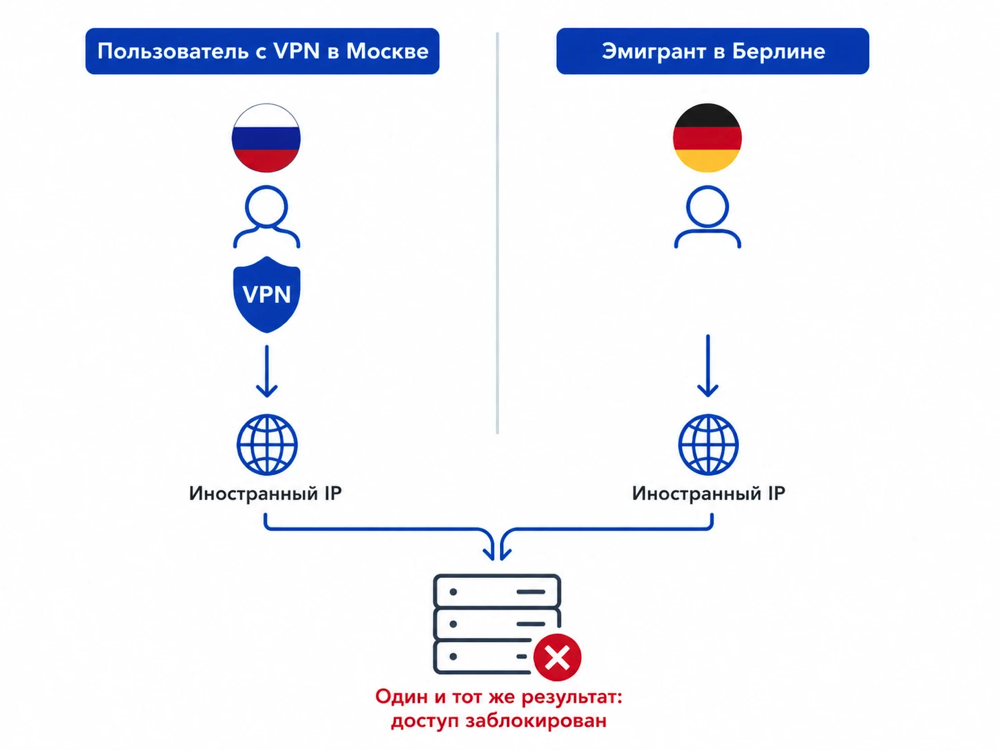
An emigrant in Berlin. VPN off. They open the app through a local ISP — an ordinary German IP, ordinary traffic. To the detection algorithm, this picture is indistinguishable from a user in Moscow with a VPN tunnelled to a German server. Foreign IP. Foreign ASN. No history of Russian traffic.
Companies pick the simple option: block all incoming traffic from foreign addresses. The domestic VPN problem is solved. Along with it, everyone physically abroad is cut off — tourists, emigrants, students, people on business trips.
Tip: If a Russian service won't open from abroad, the problem is not your device or the local ISP. The service sees a foreign IP and closes the connection at its own infrastructure level.
Who has it worst — not tourists, but those who left for good
Three scenarios: the relocated worker, the student, the property owner
The problem bites differently depending on how long ago a person left and what exactly they need.
A relocated worker in Armenia or Georgia. Left a year or two ago. Still has a Russian SIM, but permanent roaming is expensive, so they use a local carrier. Gosuslugi is needed regularly: confirming documents, ordering certificates, renewing things remotely. This group was hit first — Gosuslugi began filtering foreign IPs even before the April wave.
A student in Europe. Full-time programme. The Russian account is the main channel for money from home. After April 15 the mobile app won't load past the start screen. The confirmation SMS never arrives. Calling the bank's support line from abroad is its own quest with no guaranteed outcome.
Someone with property and obligations in Russia. The flat is rented out, the mortgage keeps running, taxes are due. All of it used to take five minutes on a phone. Now it either can't be done at all or needs a workaround of its own.
Note: Tourists suffer least — a few days of roaming covers them. Emigrants live in another country permanently. A "temporary fix" does not work as a permanent one.
Why "just turn off the VPN" doesn't help
The first tip most support desks give. Logical. Useless.
A person abroad with the VPN off still reaches the internet from a foreign IP. That is exactly what the service blocks — not the fact of a VPN, but the fact of being outside Russia. The difference between "VPN on" and "VPN off, but I'm in Berlin" means nothing to the algorithm.
- Turning the VPN off won't help while the IP is foreign
- Switching browsers or clearing the cache won't help
- Joining a different Wi-Fi network in the same country — also no
Only one thing changes the picture: swapping the IP itself for a Russian one.
What the state offers — and why it doesn't work for everyone
Roaming on a Russian SIM: exists, but costly and unreliable
The official recommendation from carriers and support desks is a Russian SIM in roaming. Technically it works: traffic flows through Russian infrastructure, the IP stays Russian, the service lets you in.
But the recommendation leaves out several problems.
| Problem | Details |
|---|---|
| Cost | Russian carriers' roaming in most countries is several times pricier than local service |
| Traffic cap | From May 1, 2026, every GB of international traffic beyond 15 GB/month costs about 150 rubles |
| Having the SIM at all | Many who left long ago swapped the Russian SIM for a local one |
| Reliability | In parts of Asia and the Middle East roaming is unstable or unavailable |
Note: Since May 2026 there is a paid threshold on international traffic. Permanent roaming burns through the 15 GB quickly. After that, every gigabyte costs money.
Corporate VPNs on the white list — a loophole that keeps narrowing
Corporate VPNs are formally allowed. RKN's white list holds around 75,000 corporate addresses. But that does nothing for an ordinary emigrant.
Only a legal entity with Russian registration can get onto the white list — private individuals cannot. And the requirements for what counts as an "approved" corporate VPN keep tightening, with no clear public criteria.
Tip: If you work remotely for a Russian company from abroad, ask your IT department whether the office VPN's addresses are entered in RKN's registry. No guarantee, but it lowers the risk of losing access to your work tools.
What actually works for reaching Russian services from abroad in 2026
The current options and their limits
By April 2026 a handful of working options had taken shape. There is no universal one — each has its own domain.
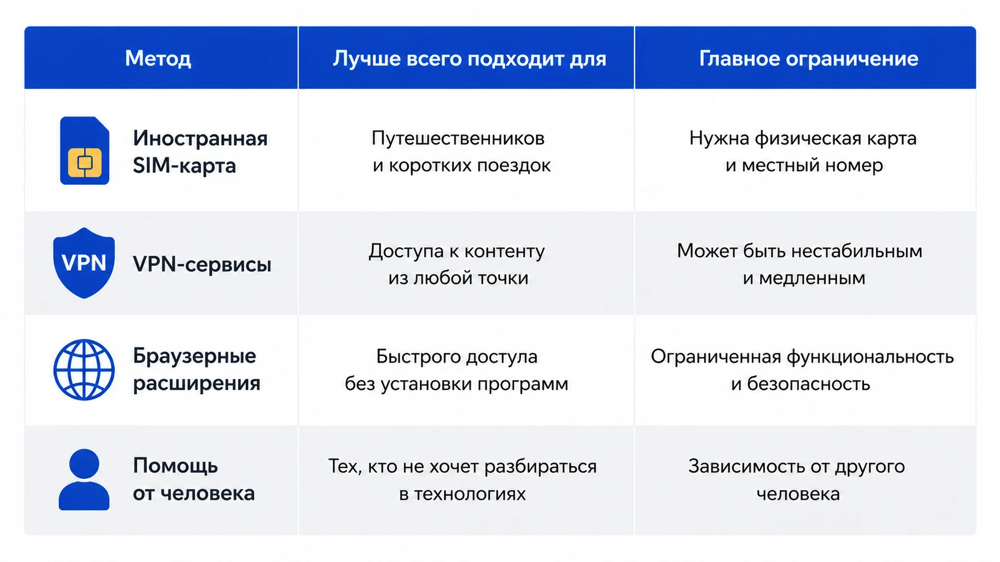
Roaming on a Russian SIM. Dependable for one-off tasks: opening Gosuslugi, confirming a bank payment. For everyday use — too expensive, and the May traffic cap narrows it further.
A VPN with a Russian IP address. The logic matters here. Most VPN services are built around exiting through a foreign IP — they solve the opposite problem. Reaching Russian services from abroad needs the reverse mechanics: an exit through a Russian IP that Russian platforms treat as one of their own.
That is exactly the task VPN Russia is built for: it gives users abroad a Russian IP address — Gosuslugi, banking apps and other Russian services work normally, without access errors and without keeping expensive roaming on at all times.
Note: When choosing a VPN for Russian services, check one thing: it must issue a Russian IP, not merely encrypt traffic. These are fundamentally different tasks with different engineering.
Browser extensions with Russian servers. Partially work for the web versions of services. Mobile apps — no: Sberbank Online or the Gosuslugi app won't run through an extension.
Through friends in Russia. Genuinely used for one-off tasks. Inconvenient — and for anything touching personal data, unsafe.
What to watch next
The situation has not settled. From May 2026 the paid threshold on international traffic joins the restrictions — roaming becomes even less attractive for people living abroad permanently.
Detection will keep tightening as the regulator raises new demands. Fixes that worked a month ago may stop. And the reverse: services purpose-built for reaching the Russian segment from abroad adapt faster than universal tools.
For anyone who needs Russian services regularly rather than once a year, choosing a tool with an explicit specialisation beats the endless hunt for the next workaround.